

 |
 |
 |
 |
 |
 |
 |
 |
 |
 |
 |
 |
 |
 |
OzSky Star Safari - Southern Skies Showcase:
Centaurus A
Centaurus A (NGC 5128)
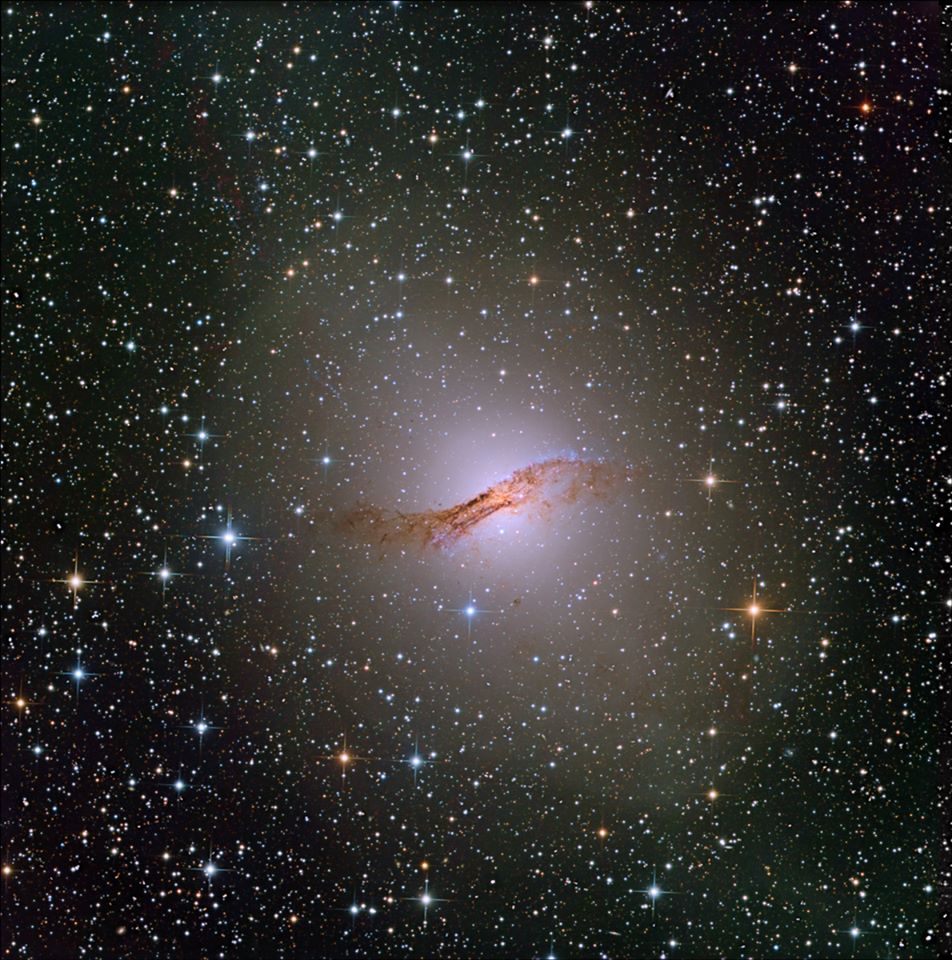
Image Credit: Mike and Trish Berthon-Jones
| R.A: | 13h 26' 30" |
| Dec: | -43° 06' 26" |
| Mag: | +6.78 |
| Const: | Centaurus (Cen) |
| Best at: | OzSky "Classic" Star Safari in April |
| Catalogs: | Caldwell 77, Arp 153, Hamburger Galaxy, PGC 46957, MCG-7-28-1, ESO 270-9, ESO-LV 2700090, IRAS 13225-4245, Dunlop 482, Bennett 60 |
Centaurus A is a spectacular Active Galaxy in the southern constellation of Centaurus (Cen) and is a strong source of radio radiation (hence the designation Centaurus A).
One of the most interesting and peculiar galaxies in the sky, and a very popular target for observers at The OzSky Star Safari, Centaurus A transits the April meridian around midnight at an impressive altitude of around 78° above the horizon.
Shining at a magnitude of +6.78 - the fifth-brightest galaxy in the sky - it is easily observed in any size telescope, especially the large telescopes at the OzSky Star Safari, but is just beyond the reach of what is easily visible to the naked eye. Some claim to be able to see it naked eye, but this author has been unable to confirm that impressive achievement to date.
Located approximately 12 million light-years (3.7 Mpc) away, and with a diameter of about 90,000 light years (27.5 kpc), it is one of the closest radio galaxies to Earth.
It is believed that Centaurus A was originally a large elliptical galaxy which collided and merged with a smaller spiral galaxy which resulted in the obvious, superimposed dust lane for which it is so well known.
Centaurus A contains a supermassive black hole at it's centre with a mass of approximately 55 million solar masses. This black hole ejects a relativistic jet which is the source of it's X-ray and radio wavelength emissions.
Centaurus A was discovered in 1826 by James Dunlop during a survey conducted at the Parramatta Observatory in eastern NSW, Australia.
References: SkySafari 5 Pro (iPhone app); Wikipedia
